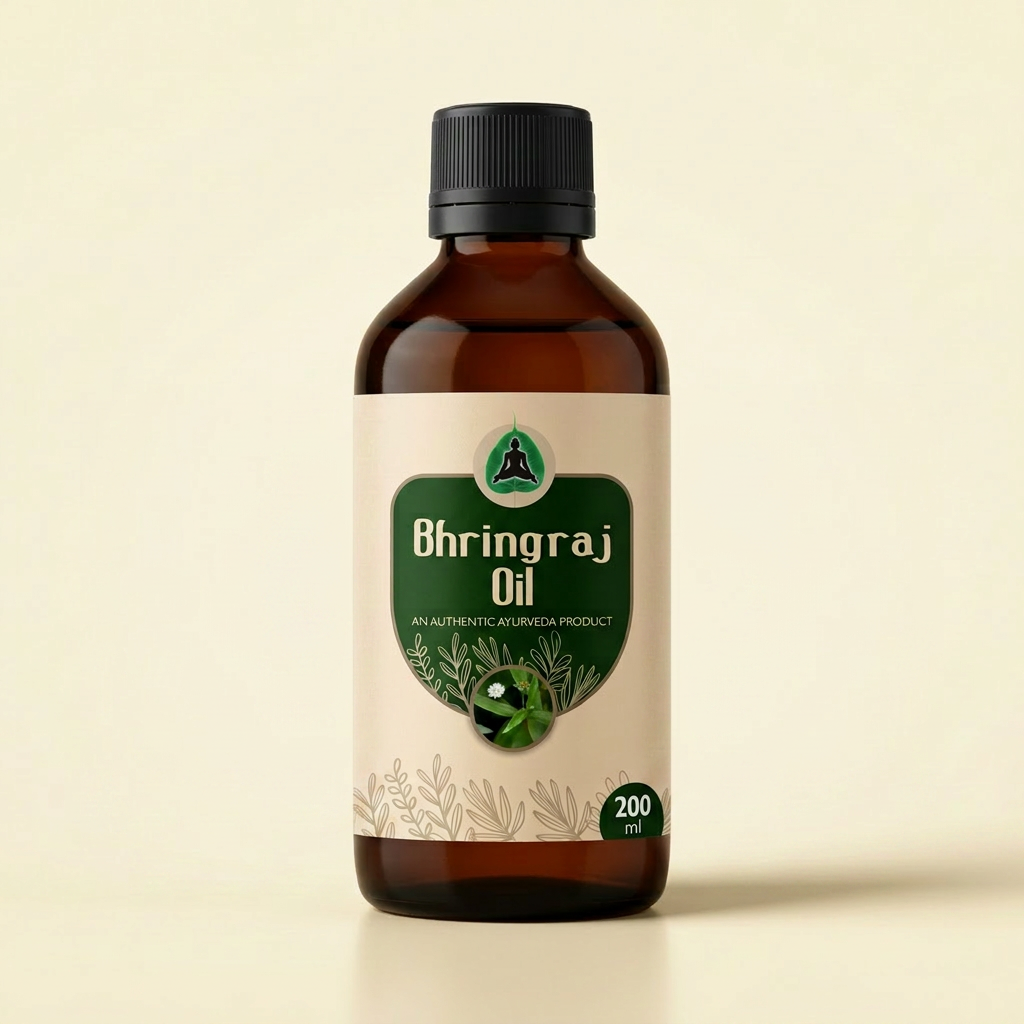
Herbal oil · For external use
Bhringaraj Oil
A traditional Ayurvedic herbal oil prepared with Bhringaraj, intended for external application. Directions and warnings are given on the product label.
View ProductEclipta prostrata · The King of Hair
Bhringraj — also written Bhringaraj, Bhringaraja or Maka
Ayurveda has long described Bhringraj — the small white-flowered herb of field margins — within its Rasayana and hair-care tradition. We bring you its traditional context, the published research, and authentic formulations from Chakrapani Ayurveda.
Authentic Ayurvedic formulations from Chakrapani Ayurveda, Jaipur.
Explore Bhringraj research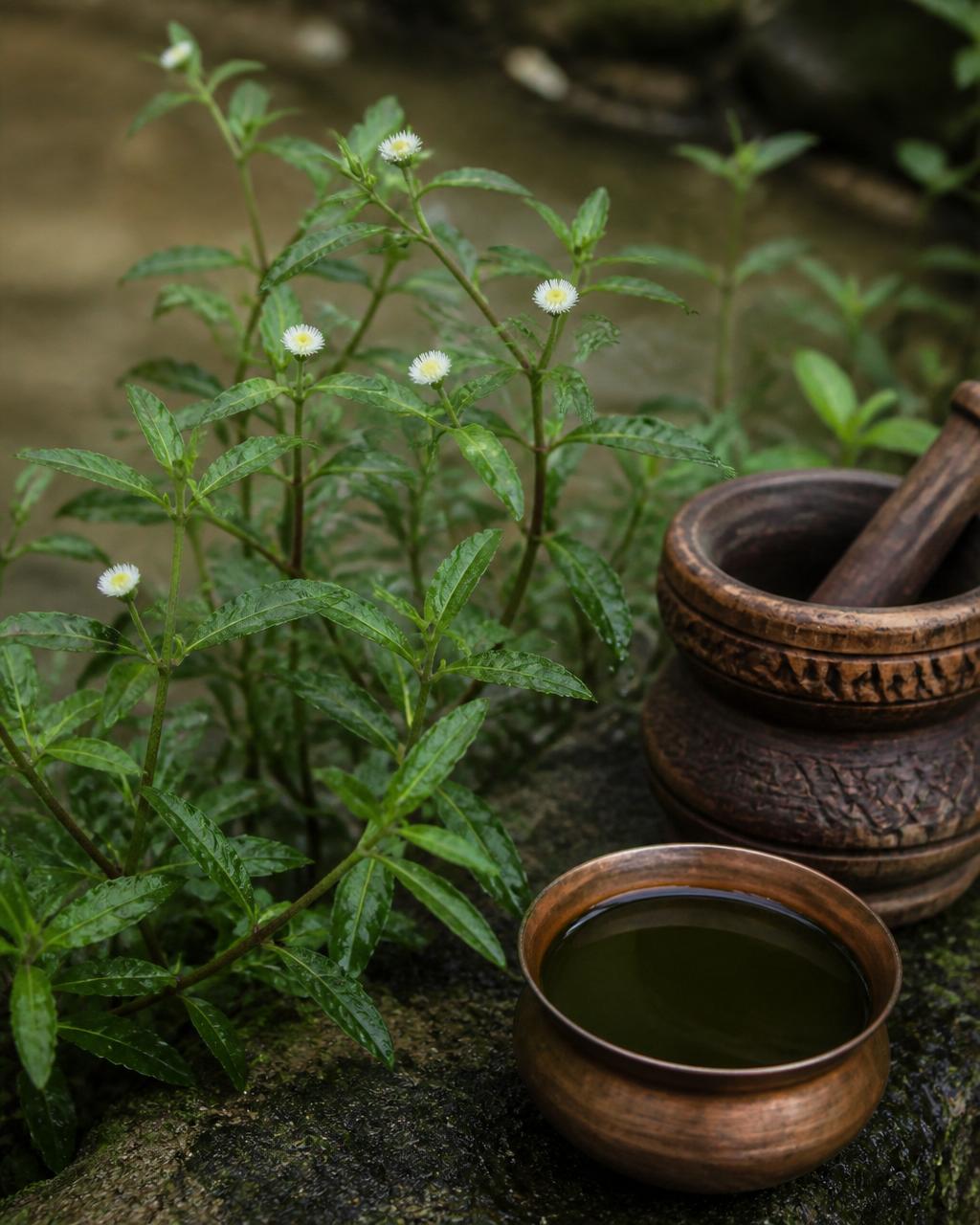
The accepted botanical name for the herb known in Ayurveda as Bhringraj; Eclipta alba remains in wide use as a synonym.
Bhringraj appears in the classical Ayurvedic textual tradition, both on its own and within compound preparations.
Product-selection and suitability questions are answered by qualified Ayurvedic physicians, not a sales desk.
Ayurveda Pharmacy
Formulated and dispensed by Chakrapani Ayurveda — available at chakrapaniayurveda.com.
Herbal oil · For external use
A traditional Ayurvedic herbal oil prepared with Bhringaraj, intended for external application. Directions and warnings are given on the product label.
View Product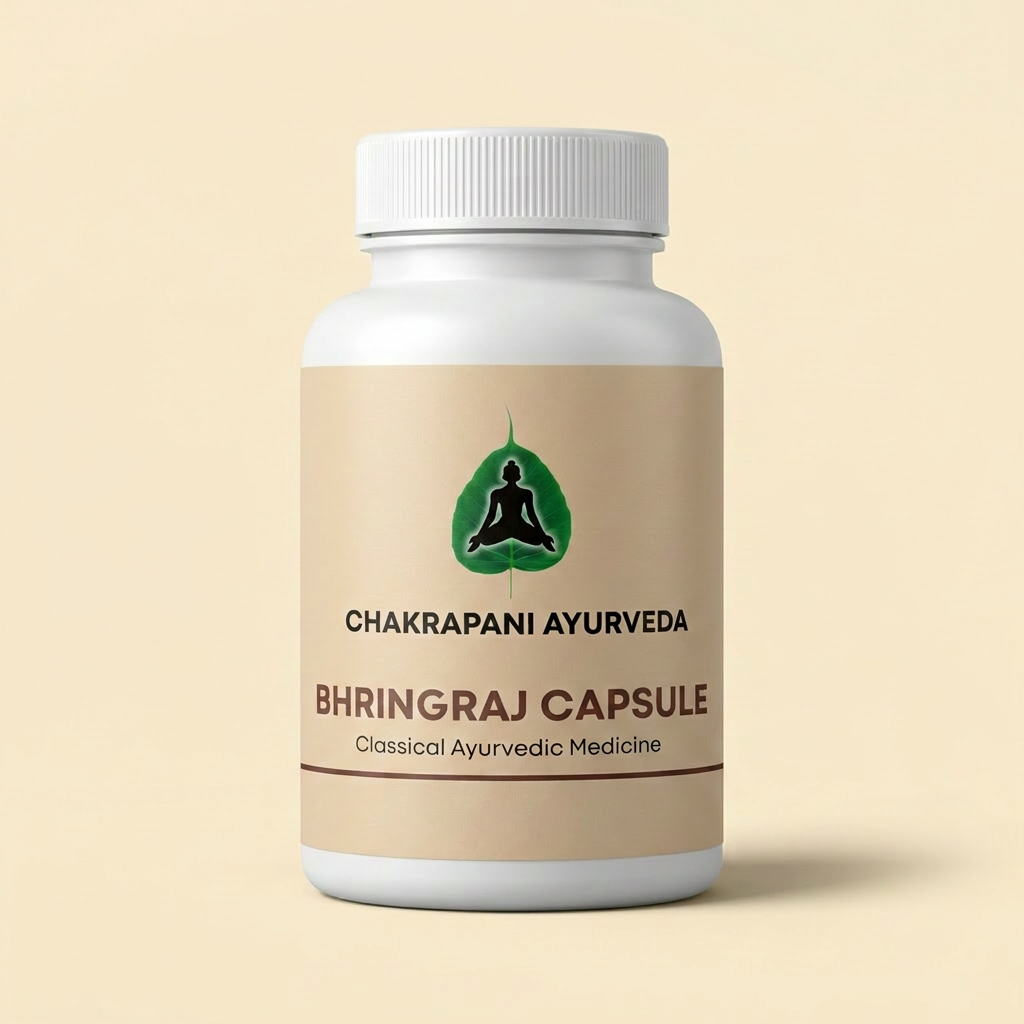
Capsules · Convenient format
Bhringraj supplied in capsule form. Pack size, directions and warnings are shown on the Chakrapani store page and on the label.
View Product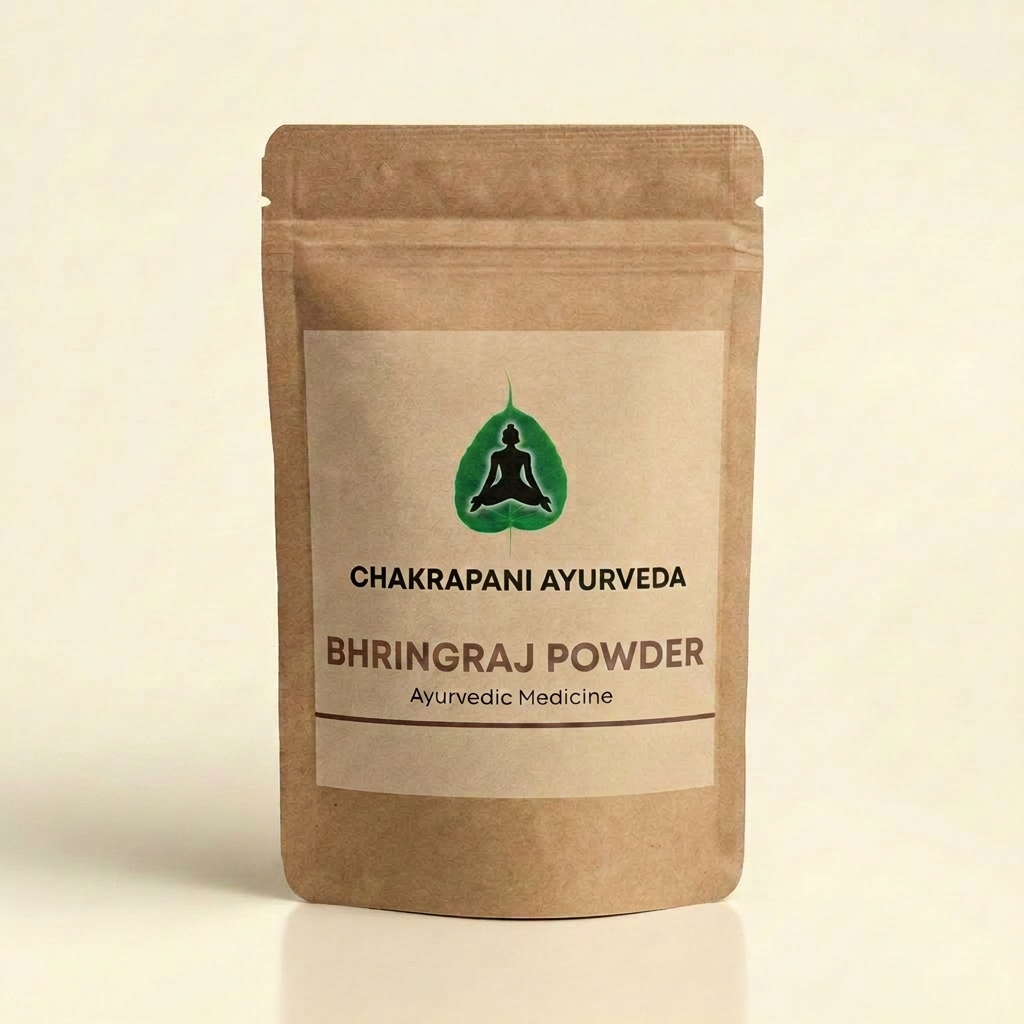
Single herb · Powder
Bhringraj single-herb powder from the Chakrapani single-herbs range, prepared from the whole plant.
View ProductFind Your Path
Receive personalised guidance from a Chakrapani Ayurveda physician.
Ask a VaidyaExplore consultations, Panchakarma and personalised care at Chakrapani Ayurveda.
Explore Chakrapani AyurvedaWhat is Bhringraj?
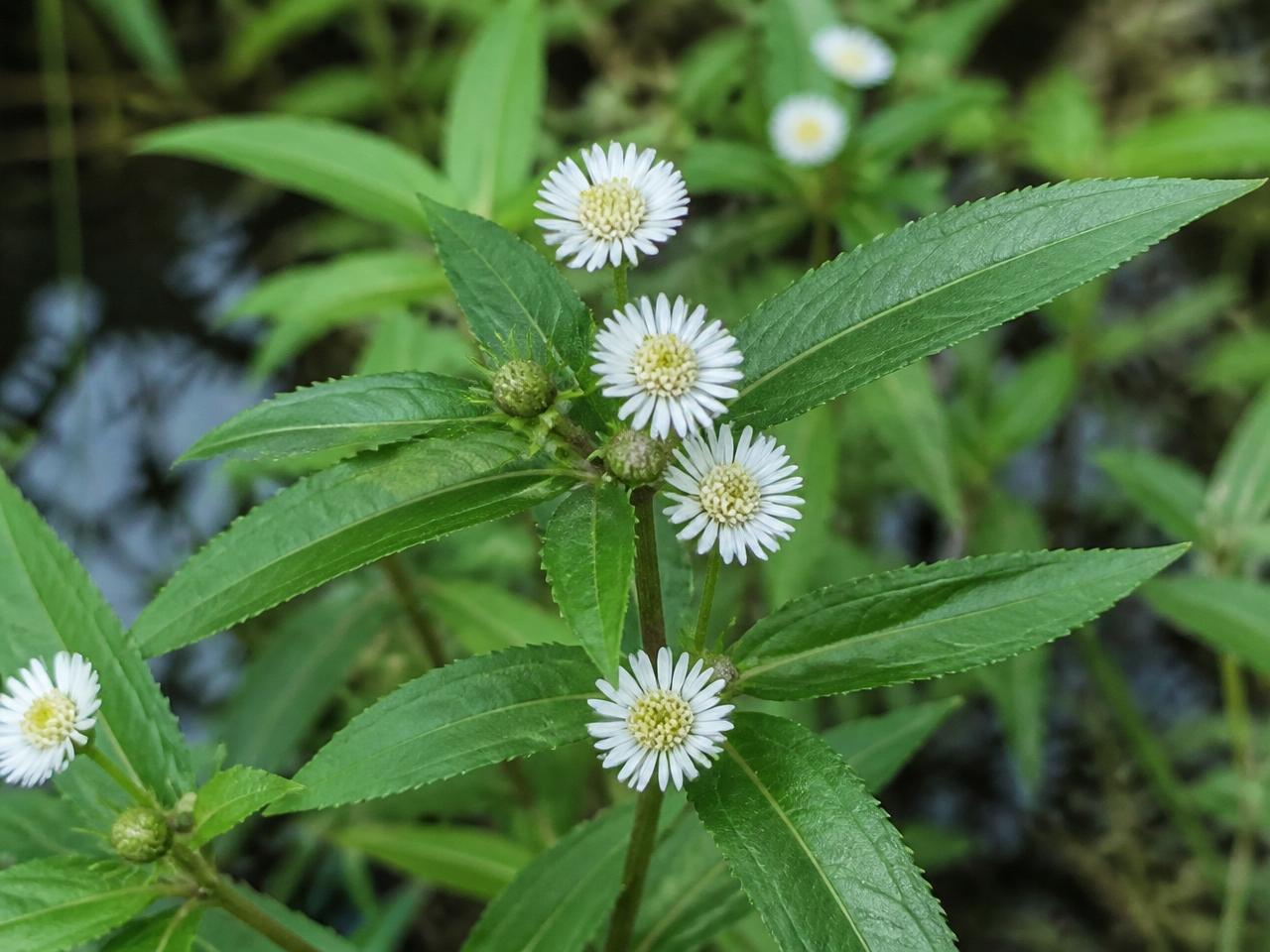
Bhringraj is the Ayurvedic name for a small herb of damp ground and field margins, recognisable by its opposite lance-shaped leaves and small white flower heads. Its accepted botanical name today is Eclipta prostrata (L.) L.; the older name Eclipta alba (L.) Hassk. is still widely used in Ayurvedic and pharmacognostic literature, and both names refer to the same plant.
Traditional Context
Traditionally described in the context of hair and scalp care, with classical oils carrying its name applied externally.
Placed by Ayurvedic texts within the Rasayana group of preparations used for sustained, restorative purposes.
Traditionally prepared as fresh juice, as a dried powder, and as a medicated oil for external use.
Recognised in the tradition by its own botanical description rather than as a branded blend.
Traditional context is not proof of a clinically demonstrated effect.
Application in Ayurveda
The notes below describe how Bhringraj is presented within the Ayurvedic textual and clinical tradition. They are attributed to that tradition rather than to modern clinical evidence, and nothing here is a diagnosis, prescription or promise of a result.
Bhringraj is traditionally described in the context of hair and scalp care, and classical oils bearing its name are applied externally rather than taken internally.
Ayurvedic texts place Bhringraj within the Rasayana group of preparations used for sustained, restorative purposes under practitioner guidance.
Traditional literature describes Bhringraj on its own and as one component of compound preparations; a compound's traditional account belongs to the whole preparation.
The tradition describes preparation as fresh juice (swarasa), as a dried powder (churna) and as medicated oil (taila), each used differently.
Identification of the correct plant is treated as part of the practice itself — a reason the accepted botanical name and its synonym are both stated here.
Classical practice assesses the individual — constitution, current state, season and other preparations in use — before any herb is considered.
Beyond Tradition
Published research on this herb is indexed under both Eclipta prostrata and Eclipta alba. The studies below examine laboratory or animal models across hair-growth signalling and liver-related endpoints.
Most of the located modern literature on Bhringraj is preclinical rather than human clinical research. Each card carries an explicit evidence classification so that laboratory work is not read as clinical proof.
The AYUSH Research Portal is a public research resource maintained by the Ministry of Ayush, Government of India. It indexes published research across Ayurveda and other traditional systems of medicine, and can be searched independently for Bhringraj.
Research resource · Ministry of Ayush, Government of India
Preclinical animal study · Archives of Dermatological Research · 2008
Roy RK, Thakur M, Dixit VK
What was studied
Petroleum ether and ethanol extracts of Eclipta alba (Bhringraj) applied to the shaved skin of male albino rats, with hair-growth parameters compared against a control and a standard treatment.
What researchers reported
The researchers reported shorter time to initiation and completion of hair growth and a greater proportion of follicles in the anagen phase in the treated animals compared with control.
Study context
This was an animal study using specific laboratory extracts applied topically. It is not evidence of an effect in people, and it does not describe any commercial product.
Preclinical animal and cell study · Journal of Ethnopharmacology · 2009
Datta K, Singh AT, Mukherjee A, Bhat B, Ramesh B, Burman AC
What was studied
A methanol extract of Eclipta alba was examined in laboratory models of hair growth, including topical application in mice and assays relating to follicular activity.
What researchers reported
The authors reported increased follicular density and a shift toward the anagen phase in treated animals under the conditions tested.
Study context
Findings come from laboratory and animal models using one prepared extract. They cannot be transferred to human use, dosage or to any specific formulation.
Preclinical animal study · International Journal of Molecular Medicine · 2015
Begum S, Lee MR, Gu LJ, Hossain MJ, Sung CK
What was studied
An Eclipta alba preparation applied to nude mice, with hair matrix keratinocyte proliferation and expression of signalling markers such as TGF-β1 measured.
What researchers reported
The researchers reported increased keratinocyte proliferation and reduced TGF-β1 expression in treated animals relative to controls.
Study context
A mechanistic animal study. It explores possible biological pathways only and does not demonstrate a clinical benefit in people.
Mixed preclinical (cell and animal) · Pharmaceutical Biology · 2019
Lee KH, Choi D, Jeong SI, Kim SJ, Lee CH, Seo HS, Jeong HS
What was studied
Extracts of Eclipta prostrata examined in cultured cells and in mice, with attention to growth-factor signalling associated with the hair-growth cycle.
What researchers reported
The authors reported changes in FGF-7 and FGF-5 expression and effects on the anagen phase in the models used.
Study context
Cell and animal work exploring mechanism. Extract type, concentration and route differ from any commercially available preparation.
Preclinical animal study · Indian Journal of Physiology and Pharmacology · 2001
Singh B, Saxena AK, Chandan BK, Agarwal SG, Anand KK
What was studied
An active fraction of an ethanolic extract of Eclipta alba leaves administered to animals in an experimental model of chemically induced liver injury.
What researchers reported
The investigators reported changes in biochemical markers of liver injury in the treated animals compared with untreated controls.
Study context
An experimental animal model of induced liver injury. It is not a study of liver disease in people and does not support self-treatment of any liver condition.
Published studies examine specific extracts of Eclipta prostrata under defined laboratory conditions. Results relate to the preparation, dose and model studied, and are not evidence of an effect in people.
Chakrapani product quality
Research about a herb is not evidence about any particular product. Chakrapani Ayurveda's product quality is established separately through raw-material selection, traditional preparation, controlled manufacturing and batch-level review.
Quality Process
Bhringraj raw material is sourced for Chakrapani's own manufacturing.
Raw material is identified against the accepted botanical description before processing.
Incoming material is screened before it enters preparation.
Oil, capsule and powder forms are prepared following classical Ayurvedic methods under controlled conditions.
Finished batches are assessed as part of Chakrapani Ayurveda's internal quality processes.
Products are reviewed before being made available for dispatch.
Explore Chakrapani
Traditionally prepared products manufactured under Chakrapani Ayurveda's quality systems.
Explore ProductsConsult with Chakrapani Ayurveda physicians for individual assessment and guidance.
Book a ConsultationExplore physician-guided Panchakarma programmes at Chakrapani Ayurveda Clinic in Jaipur.
Explore PanchakarmaDiscover courses and training for Ayurveda enthusiasts and professionals.
Explore TrainingAyurvedic Consultation
If you are unsure which Bhringraj form to consider, or whether it fits alongside what you already take, share a short note. A qualified Vaidya from Chakrapani Ayurveda will respond with product-selection and suitability guidance — not a diagnosis or a prescription.
Ask a Chakrapani VaidyaGuidance based on your situation rather than a generic recommendation.
Whether Bhringraj — and in which form — may be appropriate for you.
Direct response from a practising Ayurvedic physician.
FAQ
Bhringraj is the Ayurvedic name for a small herb of the daisy family. Its accepted botanical name is Eclipta prostrata (L.) L.; the older name Eclipta alba (L.) Hassk. is still widely used as a synonym and refers to the same plant.
Ayurvedic literature describes Bhringraj as a named single herb used both on its own and within compound preparations, and prepared as juice, powder or medicated oil. That traditional description is not the same as a clinically demonstrated effect, and it does not indicate that the herb will suit any particular person.
Chakrapani lists Bhringaraj Oil, Bhringraj Capsule and a Bhringraj single-herb powder. Current availability, pack sizes, directions and warnings are published on each product page in the Chakrapani store, and the product label is the authoritative source.
Do not stop or alter prescribed medication based on this website or without guidance from the clinician who prescribed it. If you take prescribed medicine, discuss any herbal preparation with that clinician and with a qualified Ayurvedic practitioner before starting it.
We cannot give a general yes for any of these groups. Suitability for children, and during pregnancy or breastfeeding, has to be assessed individually by a qualified practitioner, alongside the approved directions and warnings on the product label.
There is no universal duration, and we do not publish result timelines. Follow the approved product label and the advice of a qualified practitioner. Much of the modern research located for this herb is preclinical — laboratory or animal work — rather than human clinical study, so it should not be read as proof of a benefit in people.